Packing
Create a ChatGPT packing list: prompt and quantity check
Build a ChatGPT packing list with a copyable prompt, a seven-day quantity check and laundry assumptions, then keep the checked list handy in Compi.
By Compi5 min read
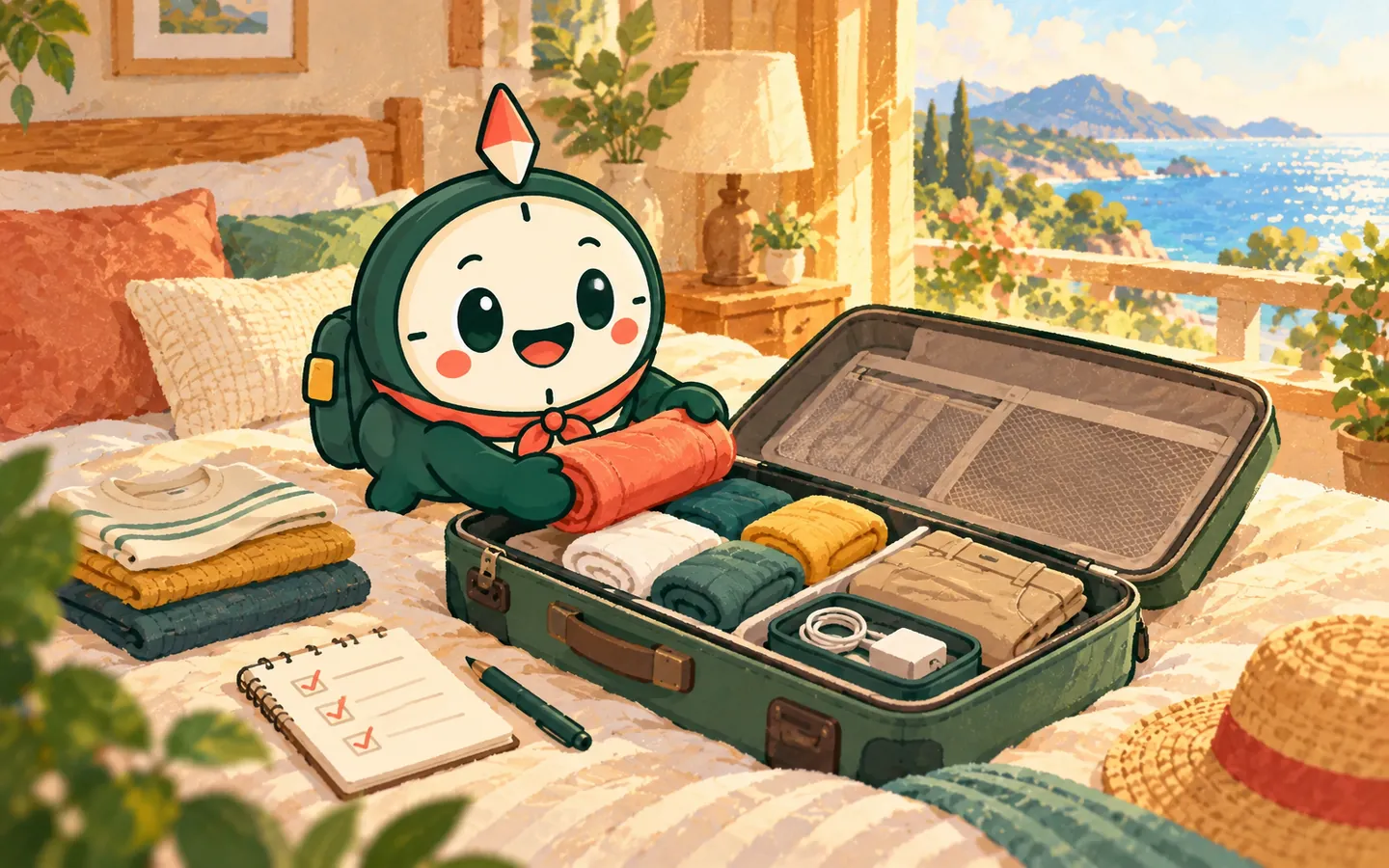
A useful ChatGPT packing list starts with trip length, travellers, activities, luggage space and laundry arrangements. Ask for per-person quantities, shared items and clothes worn on the outward journey separately. Then check whether the clean clothes last until the next wash is dry.
Four tops might cover seven days. Without the planned wash, our example runs out of fresh tops on day five. The difference often hides in “we can do laundry”. When exactly, and when will everything be dry? I'd ask that small question before closing the suitcase.
Give the chat these details first#
| Detail | A clear example |
|---|---|
| Travellers | Two adults, with separate personal lists |
| Duration | Seven days including arrival and departure |
| Conditions | Assumed mild weather; no mountain hiking |
| Activities | Walks, city visits, one swim |
| Luggage | One shared suitcase; no assumed airline dimensions |
| Laundry | Wash after day three; dry by the morning of day five |
| Accommodation | Towels provided; bring laundry detergent |
| How often you change clothes | One fresh top daily; no special evening outfits |
This is an editorial planning example, not a universal packing recommendation. Babies, sport, rain or a different frequency of changing clothes alter the quantities. Treat uncertain weather as an assumption, not an invented forecast.
Copy this packing-list prompt#
Create a packing list for [travellers and ages], spending [duration] days in [destination/month]. Include arrival and departure days. Expected conditions: [our assumption]. Activities: [list]. Luggage space or weight limit: [details]. Laundry: [washing day and when it should be dry, or none]. The accommodation provides [items]. How often each person changes clothes: [details]. First ask up to three questions that materially affect quantities. Separate per-person items, shared items, the day bag and items needed only in specific circumstances. For each entry show the total, worn on the outward journey, to pack and the reason. Avoid duplicating shared equipment. Finish with a quantity check up to the next dry laundry and three possible things to leave behind. Treat medication and entry documents as individual questions to resolve.
Spot a weak answer: it gives every person their own toothpaste, adds travelling clothes on top of its totals or says “enough socks”. Ask it to reconcile the list with your actual instructions.
Example: four tops, three in the suitcase#
In our example, each adult wears a fresh top every day. Clothes are washed after day three and ready again on the morning of day five. The table is per adult and includes travelling clothes.
| Clothing | Total / wear / pack |
|---|---|
| Tops | 4 / 1 / 3 |
| Underwear | 4 / 1 / 3 |
| Pairs of socks | 4 / 1 / 3 |
| Everyday trousers | 2 / 1 / 1 |
| Warm layer | 1 / 0 / 1 |
| Nightwear | 1 set / 0 / 1 set |
| Swimwear | 1 set / 0 / 1 set |
The second column always means total / worn on the outward journey / packed. Four tops means wearing one and packing three. Trousers are worn more than once in this example; the warm layer is for cooler periods. There is no spare nightwear set, and the swimwear can dry after the swim.
Check the tops: Wear A on day one, B on day two, C on day three and D on day four. A, B and C are washed after day three and available again from day five. They cover days five, six and seven. There is no spare change in those four tops. Add one explicitly if you need it.
Two adults therefore have eight tops in total: two worn and six packed. Personal clothing and shared equipment are different calculations.
Recalculate if you cannot do laundry#
Use this follow-up:
We can no longer do laundry. Recalculate only the affected quantities. Seven days, still with fresh tops, underwear and socks daily. Include worn items and show the difference from our previous list. Keep other items unchanged.
Each of those three categories increases from four to seven: three extra tops, three extra pairs of underwear and three extra pairs of socks per adult. One item or pair in each category is worn; six are packed. For two adults, double the additional quantities. The warm layer and two pairs of repeatedly worn trousers stay unchanged in this example.
The useful AI task is the targeted recalculation. A change in laundry should not suddenly create three new pairs of shoes and another charger.
Share equipment and separate unresolved questions#
A shared list for two adults might contain one tube of toothpaste, a suitable charger with enough ports, the cables actually needed, a laundry bag and the required detergent. Whether an adapter belongs there depends on your destination and devices.
Use the same structure for toiletries, electronics and travel documents: personal items, shared items and open questions. Keep uncertainties separate: “Are towels definitely provided?”, “Will clothes dry overnight?”, “Do both devices use the same cable?” A guess should not quietly become a completed packing task.
Use the checked list in Compi#
With an unlocked trip, you can keep packing lists in Compi. Add the checked entries directly, or give your configured connection a specific request:
Read the existing packing list for my trip [title]. Compare it with our latest agreed list. Show only missing or changed entries before saving anything. Use clear tasks such as “Person A: pack three tops”. Do not create another trip or duplicate entries.
A list in the chat is not yet saved in the app. Open the packing list afterwards and compare it with your checked version. The ChatGPT itinerary transfer guide explains the routes; the guided paste process is designed to create a trip.
Lists belong to the full travel companion. Your first trip currently includes it free of charge; see Compi's plans and pricing. For other planning tasks, try the five copyable holiday prompts.
Frequently asked questions
What details does ChatGPT need for a packing list?
Provide trip length, travellers and ages, expected conditions, activities, luggage space and laundry arrangements. Add what the accommodation provides and which items you share.
How do I avoid packing too many clothes?
Ask for worn and packed quantities separately, state the laundry assumptions and check how long clean clothes last. Quantities must match how often you actually change clothes.
Can I tick off my packing list in Compi?
Yes, with an unlocked trip. Add list entries directly or through a configured connection. A list in the chat alone is not saved in the app.
Can the list confirm my airline luggage allowance?
No. Check dimensions, weight and restrictions against your booking and the operating airline’s current information.