Travel guides
Tokyo: climate and best time to visit
When should you visit Tokyo? Compare official monthly temperatures and rainfall, understand the seasonal trade-offs and choose dates that suit your plans.
By Compi3 min read
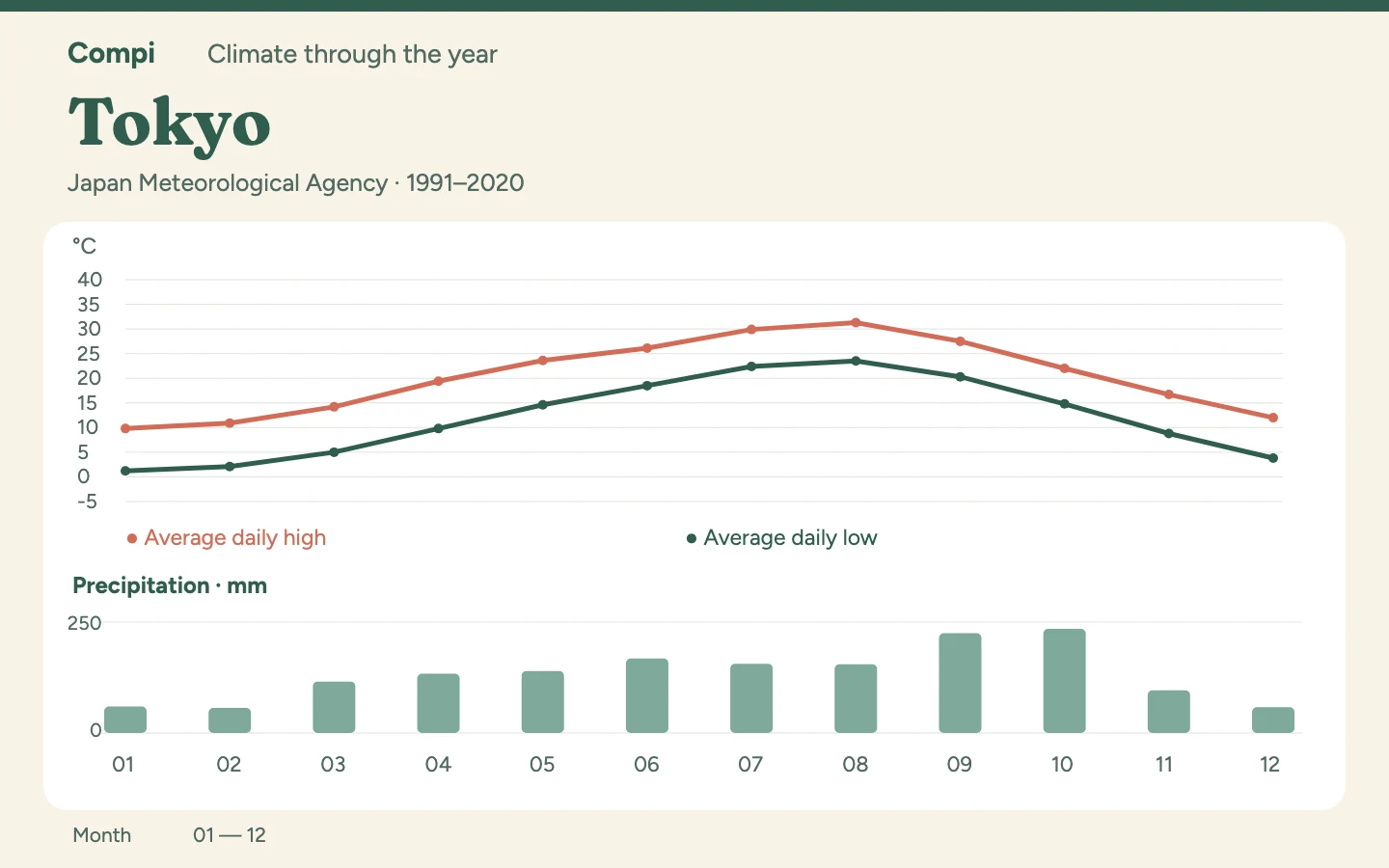
For Tokyo, I would consider May for mild city days and November for a cooler, relatively less rainy alternative. October has comfortable temperatures but is actually the wettest month in this station table: autumn does not automatically mean dry weather here. Average daytime highs exceed 30°C in August, while January calls for much warmer clothing. That distinction helps you choose between long urban walks and an itinerary with more indoor stops. Tokyo station does not describe the mountains west of the city. The temperature table also cannot supply an exact blossom date.
Climate table for all twelve months#
Source: Japan Meteorological Agency, station Tokyo, 1991–2020 normal period. The table gives mean daily maximum and minimum temperatures and mean monthly total precipitation. Wet-day counts are not shown here; they cannot be calculated from the precipitation total.
Compi transcribed the values into the table and chart and calculated the comparisons. This presentation was prepared by Compi, not by JMA.
| Month | Daily high °C | Daily low °C | Precipitation mm |
|---|---|---|---|
| January | 9.8 | 1.2 | 59.7 |
| February | 10.9 | 2.1 | 56.5 |
| March | 14.2 | 5.0 | 116.0 |
| April | 19.4 | 9.8 | 133.7 |
| May | 23.6 | 14.6 | 139.7 |
| June | 26.1 | 18.5 | 167.8 |
| July | 29.9 | 22.4 | 156.2 |
| August | 31.3 | 23.5 | 154.7 |
| September | 27.5 | 20.3 | 224.9 |
| October | 22.0 | 14.8 | 234.8 |
| November | 16.7 | 8.8 | 96.3 |
| December | 12.0 | 3.8 | 57.9 |
Two months compared directly#
May or October? Mean daily highs and lows are 23.6°C and 14.6°C in May, compared with 22.0°C and 14.8°C in October. Monthly precipitation totals are 139.7 mm and 234.8 mm respectively.
With almost identical average lows, May offers slightly warmer days and substantially less precipitation. For that combination I would choose May over October. November changes the balance: less rain again, but noticeably cooler days and nights. If you prefer October, build in flexibility for rain instead of assuming that autumn is generally dry.
Temperatures are mean daily highs and lows, not fixed limits for individual days. Precipitation in millimetres measures quantity, not duration. A wet day can still have dry hours. Use the current forecast for a particular travel day.
Choose dates around your own itinerary#
I would not book Tokyo simply on the labels spring or autumn. May, October and November lead to different decisions, even though all fall outside the hottest month.
- May: combine mild daytime figures with a layer for cooler hours.
- October: allow for substantial rainfall despite comfortable temperatures.
- November: accept cooler evenings in exchange for less rain.
If a particular natural event is the reason for your trip, use a separate timing source; this climate table answers a different question.