Travel guides
Singapore: climate and best time to visit
When should you visit Singapore? Compare official monthly temperatures and rainfall, understand the seasonal trade-offs and choose dates that suit your plans.
By Compi3 min read
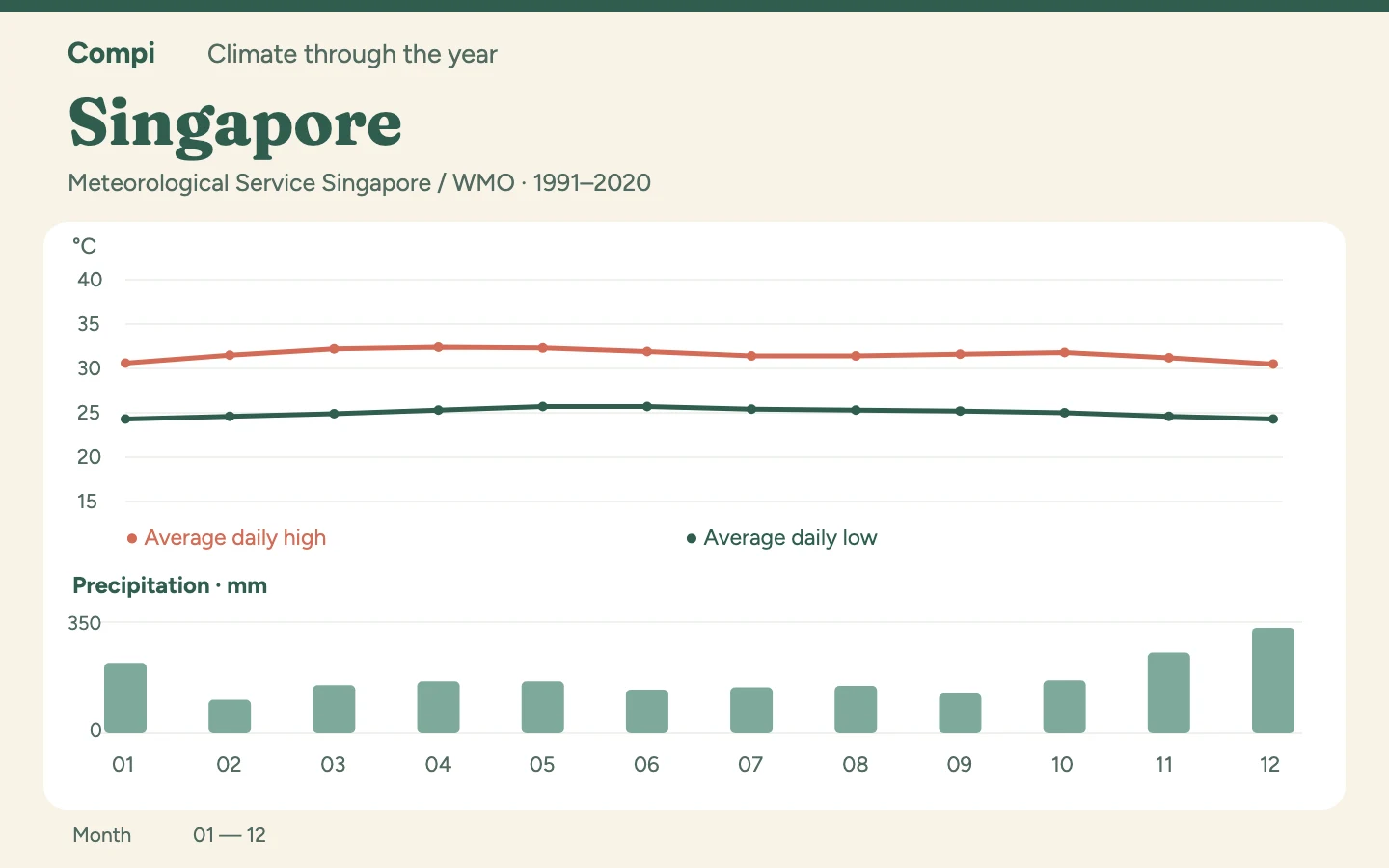
February is my first choice for Singapore if reducing rainfall matters most. It does not bring cool sightseeing weather: daytime temperatures change little through the year. December is slightly less hot but much wetter. For a short stopover, that makes a flexible daily plan more useful than searching for a completely dry season. These observations come from Changi on the eastern side of the island. I would not assume that a waterfront walk and a longer outing inland will share the same break in the rain.
Climate table for all twelve months#
Source: Meteorological Service Singapore / WMO, station 48698 Singapore/Changi Airport, 1991–2020 normal period. The table gives mean daily maximum and minimum temperatures and mean monthly total precipitation. Wet days: average number of days with at least 1 mm of precipitation.
| Month | Daily high °C | Daily low °C | Precipitation mm | Wet days |
|---|---|---|---|---|
| January | 30.6 | 24.3 | 221.6 | 10.7 |
| February | 31.5 | 24.6 | 105.0 | 6.5 |
| March | 32.2 | 24.9 | 151.1 | 9.4 |
| April | 32.4 | 25.3 | 163.8 | 11.3 |
| May | 32.3 | 25.7 | 163.8 | 11.2 |
| June | 31.9 | 25.7 | 137.1 | 10.4 |
| July | 31.4 | 25.4 | 144.8 | 10.4 |
| August | 31.4 | 25.3 | 148.9 | 11.1 |
| September | 31.6 | 25.2 | 124.6 | 9.8 |
| October | 31.8 | 25.0 | 166.4 | 12.0 |
| November | 31.2 | 24.6 | 254.1 | 15.4 |
| December | 30.5 | 24.3 | 332.1 | 16.3 |
Two months compared directly#
February or December? Mean daily highs and lows are 31.5°C and 24.6°C in February, compared with 30.5°C and 24.3°C in December. Monthly precipitation totals are 105.0 mm and 332.1 mm respectively.
February is therefore the clearer choice for lower rainfall: December offers only a little cooling in exchange for substantially more rain and wet days. If February does not fit, consider September: its rainfall total is close to February’s, although wet days are more frequent. This station table offers no cool month.
Temperatures are mean daily highs and lows, not fixed limits for individual days. Precipitation in millimetres measures quantity, not duration. A wet day can still have dry hours. Use the current forecast for a particular travel day.
Choose dates around your own itinerary#
For a short stay or stopover, I would choose the outdoor visit that matters most and keep the rest movable. A short stay leaves fewer chances to shift a rainy afternoon to another day.
- February: prioritise lower rainfall, but still pack for heat.
- December: avoid scheduling outdoor stops back to back all day.
- Year-round: identify an indoor visit in the same area that you can swap into the plan.