Travel guides
Marrakech: climate and best time to visit
When should you visit Marrakech? Compare official monthly temperatures and rainfall, understand the seasonal trade-offs and choose dates that suit your plans.
By Compi3 min read
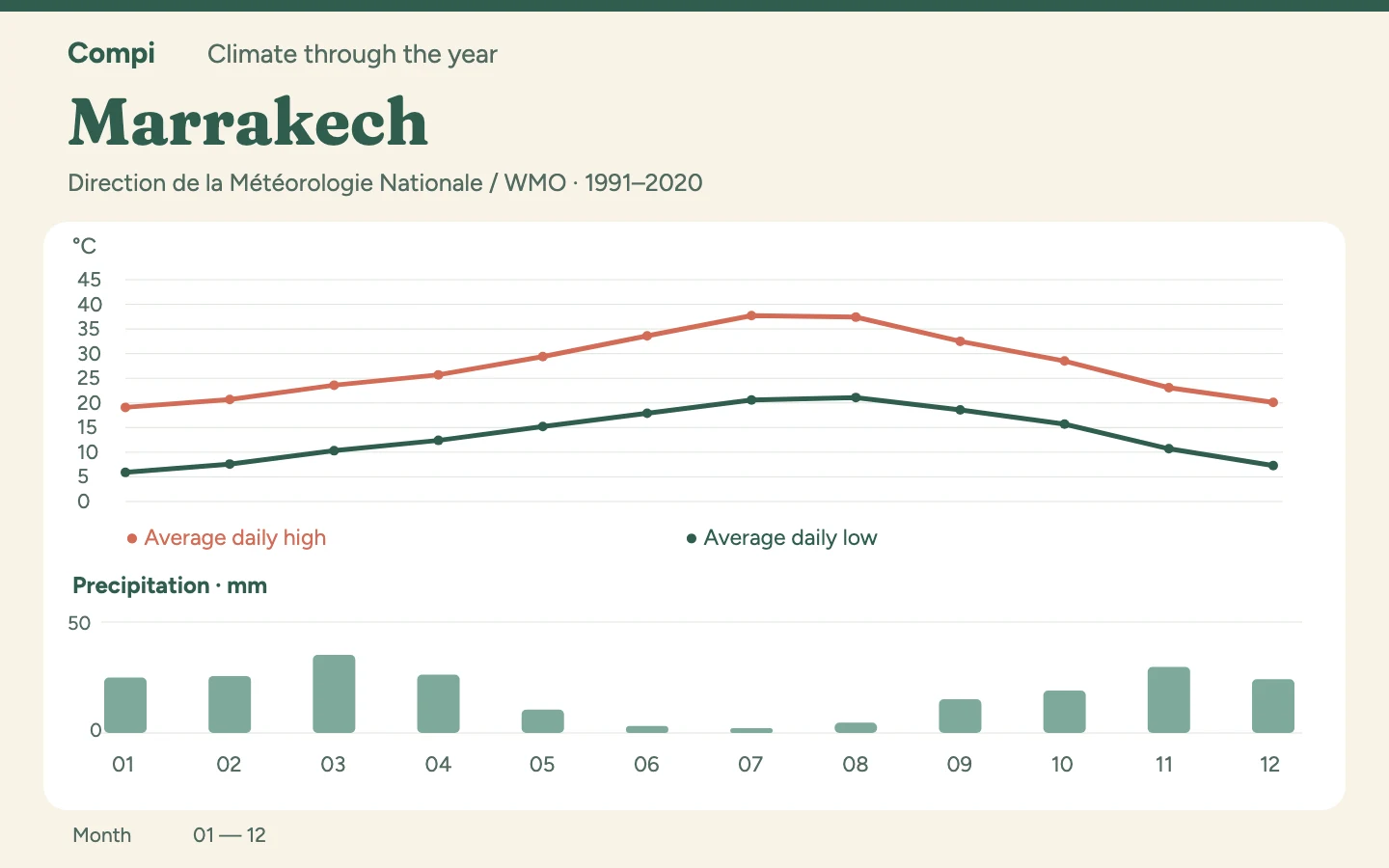
For Marrakech, I would compare April and October first if most of your exploring will be on foot. Both avoid the highest summer temperatures, but they are not interchangeable: October stays warmer. July and August receive very little rain, yet average daytime highs exceed 37°C. Dryness alone is therefore a poor way to choose your dates. In winter, the large gap between daytime and overnight temperatures matters when packing. These figures cover the Marrakech station; travelling onwards into the Atlas Mountains or the desert calls for separate weather planning.
Climate table for all twelve months#
Source: Direction de la Météorologie Nationale / WMO, station 60230 Marrakech, 1991–2020 normal period. The table gives mean daily maximum and minimum temperatures and mean monthly total precipitation. Wet days: average number of days with at least 1 mm of precipitation.
| Month | Daily high °C | Daily low °C | Precipitation mm | Wet days |
|---|---|---|---|---|
| January | 19.1 | 5.9 | 25.0 | 3.0 |
| February | 20.7 | 7.6 | 25.7 | 3.7 |
| March | 23.6 | 10.3 | 35.2 | 4.7 |
| April | 25.7 | 12.4 | 26.3 | 2.9 |
| May | 29.4 | 15.2 | 10.5 | 1.5 |
| June | 33.6 | 17.9 | 3.1 | 0.6 |
| July | 37.7 | 20.6 | 2.2 | 0.3 |
| August | 37.4 | 21.1 | 4.7 | 0.8 |
| September | 32.5 | 18.6 | 15.2 | 1.3 |
| October | 28.5 | 15.7 | 19.1 | 2.4 |
| November | 23.1 | 10.7 | 29.8 | 3.8 |
| December | 20.1 | 7.3 | 24.2 | 4.1 |
Two months compared directly#
April or October? Mean daily highs and lows are 25.7°C and 12.4°C in April, compared with 28.5°C and 15.7°C in October. Monthly precipitation totals are 26.3 mm and 19.1 mm respectively.
This is a real trade-off: April is cooler by day and overnight, while October is a little drier. For long walks I would give more weight to April’s lower temperatures; for warmer evenings, October has the advantage. November reduces the heat further but calls for extra clothing in cooler hours. The small rainfall difference should not overshadow that temperature decision.
Temperatures are mean daily highs and lows, not fixed limits for individual days. Precipitation in millimetres measures quantity, not duration. A wet day can still have dry hours. Use the current forecast for a particular travel day.
Choose dates around your own itinerary#
For Marrakech, I would work through your daily rhythm: how much time will you spend outside during the day, and how often will you stay out into the evening? That is where the two temperature columns become useful.
- April: plan for milder highs but considerably cooler nights.
- October: expect more warmth instead of treating it as identical to April.
- July/August: avoid filling the hot part of the day with long walks.
- Winter: bring extra layers for early and late hours, even when afternoons look mild.